PioneersEntrepreneurship for kids aged 9-11
Big imagination. Their very own idea. Turn a wild idea into a real business: spot problems worth solving, design a product, run a cookie-business simulator, build a brand, set prices that make a profit and pitch it.
Ages 9-11 (6-8 with a grown-up). 9-11s can work on their own; 6-8s do best with a grown-up alongside.
- About 4 hours
- 10 modules
- Junior Founder certificate
- Module 1 free
No card needed · £29 once unlocks every course for the whole family
What is the Pioneers course?
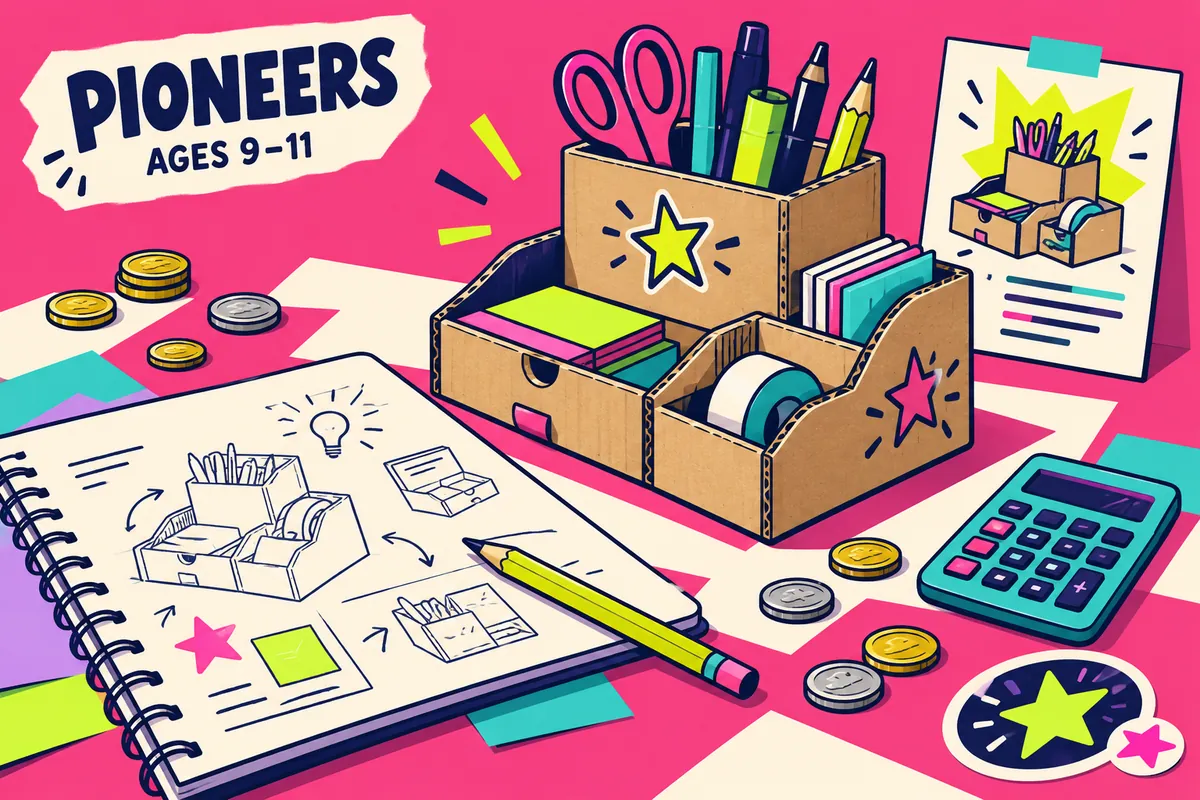
Pioneers is an online entrepreneurship course from We Can Be for children aged 9-11. Help their “what if?” become something they can create, price and proudly present. Through story reels and games, children spot everyday problems, find out what customers really want, design a prototype and discover how money works in a business. They'll invent a brand and design a poster, then bring it all together in a one-minute pitch and a one-page plan of their own idea. It has 10 modules and around 4 hours of learning, plus time for practical tasks. The first module is free, and £29 paid once unlocks every course for the whole family.
What they learn
- Spotting problems and ideas
- Asking customers good questions
- Prototyping
- Costs, prices and profit
- Branding and posters
- Pitching an idea
- Using AI safely to spark ideas
What they finish with
- A prototype of their own idea
- A brand kit and a poster
- A costed first batch and a profit plan
- A one-minute pitch and a one-page plan
- A personalised Junior Founder completion certificate
The Pioneers route: 10 modules
- You are hereWelcome to the Spark Squad
- Think Like an Entrepreneur
- Idea Treasure Hunt
- Happy Customers
- Make It Real
- Money Maths Magic
- Brand Me Brilliant
- Tell Your Story
- Grow Bigger
- Celebrate & Shine
Every module, step by step
Welcome to the Spark Squad
What a business is, and finding your spark
Unlock the rest of Pioneers Academy - £29 lifetime
Module 1 is free. Get the remaining 9 modules + all 3 courses for one-off £29.
- All 3 courses (ages 9-18)
- AI tools + worksheets
- Badges & certificates
- Lifetime updates
Think Like an Entrepreneur
Discover your entrepreneur superpowers
Idea Treasure Hunt
Find problems worth solving
Happy Customers
Find out what people really want
Make It Real
Turn ideas into things you can touch
Money Maths Magic
Master the numbers game
Brand Me Brilliant
Create your business identity
Tell Your Story
Spread the word about your business
Grow Bigger
Take your business to the next level
Celebrate & Shine
Show the world what you've built
Junior Founder completion certificate
Complete all 10 modules to earn your personalised completion certificate!
Loading progress...
Pamela Aculey
MIXD Reality
"Pamela created something that did not exist and showed that a new idea can become real."
Collect every big idea
Finish a module to collect its cards. Tap a card to see what it means.
0 of 51 collected
For parents and carers
Each module has two simple ways to help at home, and what stays with a grown-up: going online, talking to people they don't know, and money.
Module 1Welcome to the Spark Squad
What they're doing
Your child meets Spark the fox and learns what a business is: a customer, a product or service, and a price. They spot the business at a school fair stall, sort products from services, then mix what they love with what bugs them to find first ideas.
Two ways to help
- Next time you're out, point at a shop, café or service and ask "Who's the customer here?" The optional Business Spotter task is exactly this, so a trip to the shops counts.
- When they get to Find Your Spark, share something that bugs you at home, like lost socks or a messy shoe pile. Everyday niggles make great starting points.
Staying safe
Everything here happens on screen or at home with you. Any looking-up of businesses or founders online happens with a grown-up nearby.
Ask them: What's the difference between a product and a service?
Module 2Think Like an Entrepreneur
What they're doing
Your child is finding their founder superpower, such as curiosity, kindness or not giving up. They spot "give-up thoughts" after a lemonade stall has a bad day, and make choices for a pretend first week as a founder.
Two ways to help
- Tell them which superpower you see in them, and give a real example. Children this age often don't notice their own strengths until someone names them.
- Share a time something went wrong for you and what you tried next. It shows that a setback is part of the story, not the end of it.
Staying safe
The founder's week is a pretend story. The optional poster task is paper and pens at home, and nothing is shared online without a grown-up.
Ask them: What would you say to a friend whose stall had a bad day?
Module 3Idea Treasure Hunt
What they're doing
Your child is hunting for problems a business could help fix, then twisting everyday things into silly new ideas. They finish by using the AI Idea Machine to turn their spark into ideas they could really start.
Two ways to help
- Sit with them while they use the AI Idea Machine. Ask "Which of these could you really try?" and help them pick one they like.
- Go on a problem hunt around the house together: what spills, breaks, gets lost or takes too long? This is the optional Problem Hunt task.
Staying safe
Use the AI Idea Machine with a grown-up nearby. Your child should never type their full name, school or address into it, and should check anything surprising with you.
Ask them: What's a problem you noticed this week that a business could fix?
Module 4Happy Customers
What they're doing
Your child is learning to find out what customers really want. They practise asking questions that get honest answers rather than polite ones, then handle tricky customer moments, like a wrong order, in a role-play game.
Two ways to help
- Let them ask you questions about their idea. Gently point out if a question is a "Would you buy it?" one, and help them ask about what you actually do instead.
- Talk about a time a shop put something right for you, or didn't. What did they say, and how did it make you feel?
Staying safe
If they want to try the optional Real-Person Test, it's with family or people they already know, in person, with a grown-up there. No messaging strangers online.
Ask them: What question gets a real answer instead of a polite one?
Module 5Make It Real
What they're doing
Your child is learning about prototypes: a simple first version you can show people before making the real thing. They put build, test and improve in order, design a digital mock-up in the Prototype Studio, and decide what to do with feedback.
Two ways to help
- Be the tester. Look at their mock-up and say one thing you like and one thing you'd change. Honest, kind feedback is what this module is about.
- If they want to make the optional recycling-box model, gather card, tape and old boxes together. Rough is fine: it's a test, not a finished product.
Staying safe
Keep a grown-up nearby for scissors or glue. Buying any materials, especially online, goes through you first.
Ask them: What would you change in version 2, and why?
Module 6Money Maths Magic
What they're doing
Your child is learning about costs, prices and profit. They add up what one bracelet costs to make, plan a first batch, then run a pretend cookie business and see what happens when they change the price.
Two ways to help
- Check their sums with them. Profit is the price minus what it cost to make, and small costs like string or packaging are easy to forget.
- On a shopping trip, compare the price of two similar things and ask why one costs more. This is the optional Real Price Check task.
Staying safe
All the money in this module is pretend. Any real buying or selling goes through a grown-up, and price searches online happen with you.
Ask them: If something costs 30p to make and sells for £1, how much profit is that?
Module 7Brand Me Brilliant
What they're doing
Your child is giving their idea a brand: a name, a logo, colours and fonts that help people remember it. They try out names in the Name Generator and design their own brand kit.
Two ways to help
- Ask "Why that colour?" or "Why that name?" Explaining a choice helps them think about what they want people to feel.
- Look at the logos on things in your kitchen together. Which ones could you recognise without the words?
Staying safe
If they try the optional Name Vote, it's with family and people they already know. Any online design tools or pictures from the internet are used with a grown-up.
Ask them: What do you want people to feel when they see your brand?
Module 8Tell Your Story
What they're doing
Your child is learning how to tell people about their idea. They find the mistakes on a bake sale poster, share out a pretend £20 to get people to a stall, then design their own poster.
Two ways to help
- Look at their poster from across the room. Can you tell what it's selling, when and where? If not, help them make the most important words bigger.
- Spot adverts together on a walk or on TV and ask "Who is this for, and what does it want you to do?"
Staying safe
Children don't post anything online. If they want to put their poster up for the optional Poster Test, a grown-up chooses where, and it has no full names, school or contact details on it.
Ask them: What does your poster tell people to do next?
Module 9Grow Bigger
What they're doing
Your child is finding out how businesses get bigger. They sort signs that a business is ready to grow from signs it isn't yet, then make growth choices in the Build Your Empire game.
Two ways to help
- Talk about a local business you know that has grown, such as a café that opened a second shop. What do you think helped it?
- Ask them to explain one choice they made in the game and what happened. Talking it through helps the idea stick.
Staying safe
The game uses pretend money and decisions. If they want to ask a business owner how it grew for the optional task, a grown-up arranges it and is there.
Ask them: How do you know when a business is ready to grow?
Module 10Celebrate & Shine
What they're doing
Your child is building a one-minute pitch for their idea, then pitching it to the family and counting the votes. They finish with Professor Hoot's challenge, one question from every module, and collect their Junior Founder certificate.
Two ways to help
- Be the audience for the Family Vote, ideally at tea time. Listen to the whole pitch before you ask anything, then vote honestly.
- Afterwards, ask one kind question, like "Who is it for?" Practising an answer builds confidence for next time.
Staying safe
Pitching happens at home or with people you know. Sharing a video of the pitch, or their certificate, online is a grown-up's decision, with no personal details.
Ask them: What's the first thing you say to grab people's attention?
Questions parents ask about Pioneers
Who is Pioneers for?
Pioneers is written for children aged 9-11. Confidence, interests and support needs matter alongside age, and the free first module lets you check the language and level before committing.
How long does Pioneers take?
Allow around 4 hours of learning across 10 modules, plus time for practical work. Progress saves automatically, so they can work at their own pace.
What happens in the free first module?
The first Pioneers module introduces business basics with Spark, a school fair game and Find Your Spark. No card is needed to start.
Will they receive a certificate?
Yes. Completing the course earns a personalised Junior Founder completion certificate. It recognises course completion; it is not an accredited qualification.
Can a 9-year-old do Pioneers on their own?
Many 9-11-year-olds can. Story reels, games and read-aloud keep reading light, and tasks away from the screen are optional. Children aged 6-8 can try the first module with a grown-up alongside.
Is Pioneers just for girls?
No. We Can Be is built with girls in mind, with real female founders throughout, because girls can't be what they can't see. Every course is open to everyone.
How much does Pioneers cost?
The first module is free. Standard family access is a one-off £29 for all three courses, the full toolkit, unlimited Blaze AI coaching and child profiles, with lifetime access and no subscription.
The other routes
 Ages 12-14InnovatorsEntrepreneurship course for ages 12-14
 Ages 15-18TrailblazersStartup and AI course for young entrepreneurs aged 15-18
Not sure which?
Compare all three courses by age, school stage, time and what they make.
Compare the courses